
As a facilities manager overseeing industrial manufacturing facilities or warehouses in the Twin Cities, you know that your concrete infrastructure is the foundation—literally—of your daily operations. But how do you know when it’s time to move beyond patching and repairs to complete concrete slab replacement?
After 40+ years installing and replacing commercial concrete throughout Minnesota’s industrial facilities, we’ve seen it all. This guide will help you identify the warning signs that your facility needs new concrete, understand the risks of delaying replacement, and make informed decisions that protect your operations and budget.

The True Cost of Deteriorating Concrete
Before diving into the warning signs, let’s talk about what’s at stake. Failing concrete isn’t just an eyesore—it’s a liability that impacts:
Safety & Risk Management
- Trip hazards leading to employee injuries and workers’ compensation claims
- OSHA violations and potential fines
- Liability exposure from visitor accidents
- Equipment damage from uneven surfaces
Operational Efficiency
- Slowed material handling and forklift operations
- Damaged inventory from unstable storage surfaces
- Downtime during emergency repairs
- Restricted access to critical facility areas
Financial Impact
- Escalating repair costs as problems compound
- Lost productivity from operational disruptions
- Increased insurance premiums after incidents
- Decreased property value and lease rates
Now let’s look at the specific signs that indicate it’s time for replacement rather than another patch job.
1. Widespread Cracking Throughout Your Facility
A few hairline cracks are normal, but extensive networks of interconnected cracks (alligator cracking), structural cracks wider than ¼ inch, or cracks that reappear after repairs signal serious underlying issues. If you’re patching the same areas twice annually, or cracks cover more than 20% of your floor, replacement becomes cost-effective.

2. Severe Spalling and Surface Deterioration
When concrete surfaces flake, chip, or peel away exposing aggregate underneath, it typically indicates poor-quality installation, moisture issues, or chemical exposure in interior facilities. Interior spalling often results from inadequate curing during installation, deicing salts tracked in from loading docks, chemical exposure from industrial processes, or moisture vapor transmission from below the slab. Once spalling begins, it accelerates rapidly as more surface area becomes exposed and vulnerable. When it affects more than 15% of your floor area or critical zones like loading docks, replacement should be considered.

3. Significant Settlement and Uneven Surfaces
Sunken areas, pooling water, or height differences exceeding ½ inch indicate subgrade failure beneath your concrete. Surface repairs won’t fix fundamental structural issues. Widespread settlement affecting multiple areas, or settlement greater than 2 inches, typically requires complete replacement with proper subgrade preparation.
4. Inadequate Load Capacity
Your operations may have evolved beyond your concrete’s original design. Visible deflection under heavy equipment, cracking under racking systems, or surface wear from increased forklift traffic indicates inadequate load capacity. When operational demands exceed design specifications—especially before adding heavier equipment—strategic replacement prevents catastrophic failure.
This video below shows our team doing a full concrete slab replacement for Activar in their Eden Prairie industrial manufacturing facility. This slab was poured to spec and will support new pieces of industrial equipment.
5. Chronic Moisture Problems
Standing water that won’t drain, white chalky deposits (efflorescence), or perpetually damp spots indicate improper slope, failed drainage, or missing vapor barriers. Moisture accelerates all other deterioration through freeze-thaw damage and reinforcement corrosion. If problems persist despite repairs, replacement with proper drainage design is the lasting solution.
6. Age and Repeated Coating Failures
Concrete approaching or exceeding 30 years in high-traffic industrial areas should be proactively replaced. Additionally, if coating systems repeatedly fail despite proper application, the concrete substrate has moisture transmission or surface deterioration issues no coating can overcome.
Repair vs. Replace: The Decision Framework
Consider repair when:
- Damage affects less than 20% of total area
- Problems are isolated with identifiable causes
- Concrete is less than 15 years old with good initial quality
Plan for replacement when:
- Multiple warning signs occur simultaneously
- Problems are widespread across large areas
- Safety concerns are escalating
- Operational efficiency is significantly impacted
- Total repair costs approach 50% of replacement cost
Minimizing Disruption During Replacement
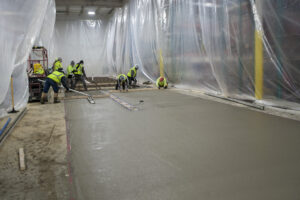
Experienced commercial concrete contractors use strategic phasing to maintain operations during concrete replacement—dividing facilities into zones, using fast-track concrete mixes, implementing dust control systems, and scheduling around your operational needs. We understand that shutting down isn’t an option. That’s why we deploy professional dust containment barriers (like the one shown in the image above) that completely isolate the work area, preventing concrete dust from reaching your production lines, contaminating products, or affecting air quality. Your team continues working on one side of the barrier while we pour precision concrete on the other. We coordinate material deliveries around your shipping schedules, and maintain clear forklift traffic routes throughout the project. The result: new concrete without production interruptions.
Don't Wait for Catastrophic Failure
Proactive replacement on your timeline costs significantly less than reactive emergency work. It allows you to upgrade specifications, improve operations, and eliminate the constant patch-and-repair cycle.
Schedule Your Free Facility Assessment
Randahl Construction offers complimentary concrete assessments for industrial facilities throughout the Twin Cities, including visual inspection, problem identification, priority recommendations, and budget estimates for both repair and replacement options.
Contact us today: 📞 (763) 559-1009
With 40+ years serving Minnesota’s industrial facilities, we understand your challenges and have the expertise to solve them. Let’s discuss how we can protect your facility investment and maintain safe, functional operations for years to come.